

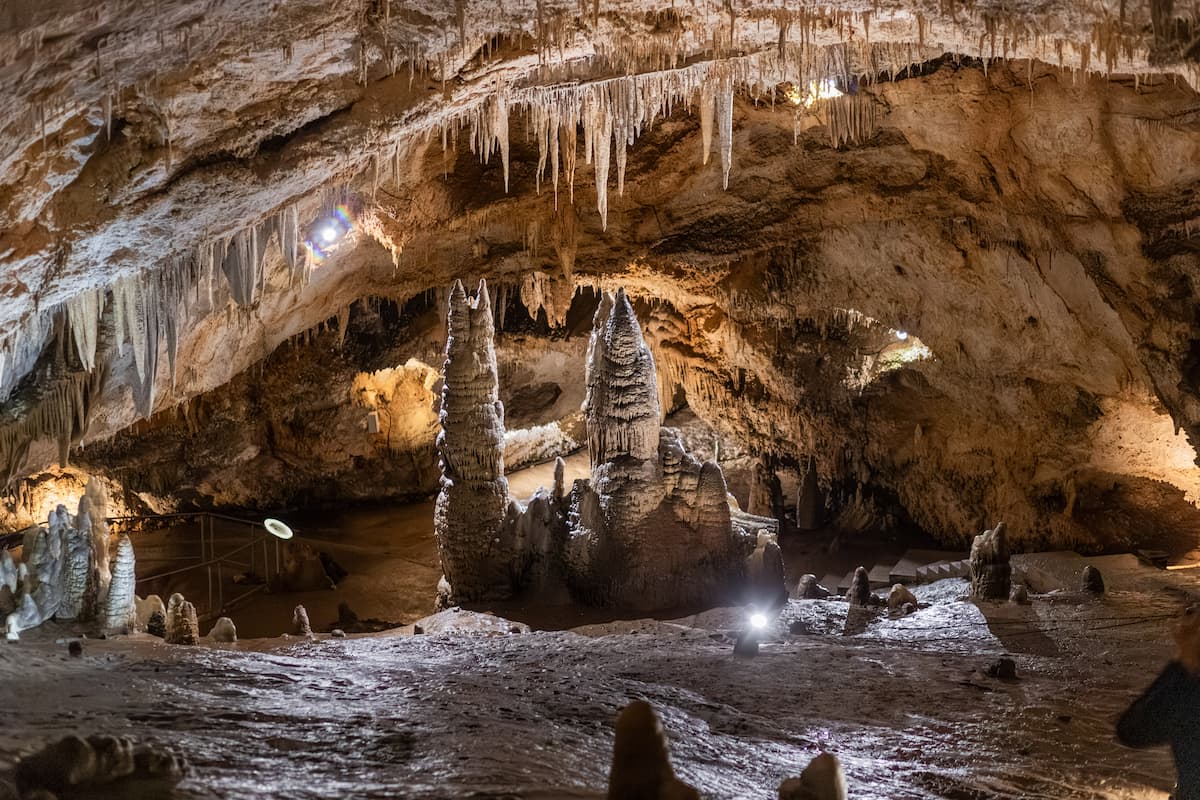
In the silence of Dobrsko village, nestled deep beneath the surface and the canopies of fragrant linden trees, lies Lipa cave – a place where time is measured by drops of water, and history is written through human curiosity and courage.
With questions in their minds, a torch in one hand and a rope in the other, the first visitors set out to explore, unaware of the world that had existed beneath their feet long before the first human ever walked the Earth. In the first half of the 19th century, a shepherd’s dog accidentally fell through the Pit entrance, setting in motion a series of events that led to you reading this blog today.
Petar II Petrović Njegoš is considered a true pioneer of Lipa cave exploration. Namely, he was the one who issued an order for detailed research of the cave, a call to which many explorers responded. In his honor, and as a symbol of awakening the spirit of exploration, one of the largest chambers bears his name.
By the mid-20th century, news of Lipa cave had spread far beyond Montenegro, reaching travel writers, researchers, and adventurers who left written records of its beauty and richness. The earliest known written record dates back to 1839 and was authored by the famous English adventurer Henry Layard. He was followed by, among others, the renowned German travel writer and botanist Wilhelm Ebel, Russian geographer Pavel Rovinsky, and the founder of modern speleology, Édouard-Alfred Martel.
Until the arrival of the Austro-Hungarian army, the Pit entrance was the only access point to the cave. During the First World War, the Austro-Hungarians broke through an artificial entrance, which was later completely renovated. A third entrance, the Fossil entrance, was discovered later, but it no longer serves its original purpose today.
The first published sketch and a more detailed description of Lipa cave were created in 1905 by Gessmann, at which time the cave had been explored to a depth of 890 meters. During the First World War, under Austrian occupation, speleologist Lahner explored numerous cave sites across Montenegro in search of water and left valuable data on Lipa cave. In 1929, the entrance gate was built and partial tourist development was carried out to a depth of 400 meters into the cave. After this period, research of the cave was interrupted for a longer time and resumed only in the 1960s.
In 1968, Lipa cave was declared a Natural Monument, ensuring permanent protection of this unique underground world, home to numerous endemic and relict species.
Join us on a tour and experience another world beyond words.